Chased by the River, Rebuilt by Resilience: Aisha’s Fight for a New Home
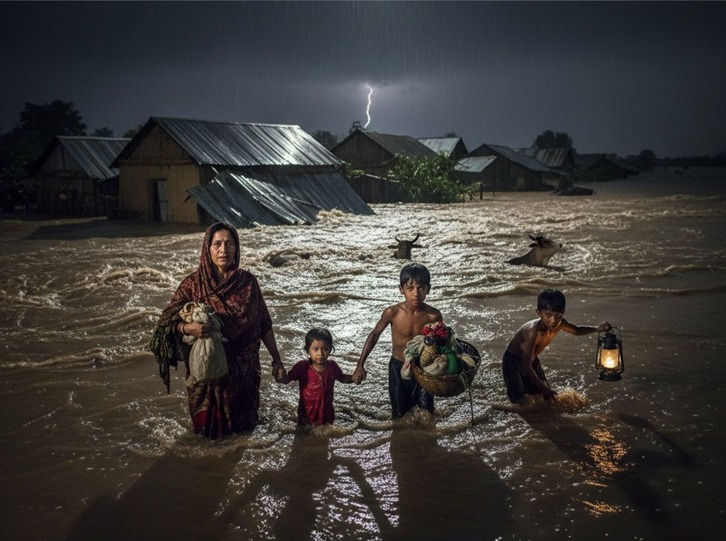
The night was heavy, the kind of darkness where even the stars seemed afraid to shine. In a small riverside village of Sirajganj, Aisha Begum lay awake, her three children curled beside her on a straw mat, their soft breaths rising and falling in fragile rhythm. The Jamuna River, usually a distant hum, had turned into a living beast. It growled in the blackness, its waves thrashing like restless arms, clawing closer with every surge. The air smelled of wet earth and silt, thick with the warning of disaster.
Suddenly, the ground quivered under her. Aisha’s eyes widened. She knew. The river had come for them.
“Tipu, Sohan, Smrity - wake up!” she cried, her voice sharp with terror. She shook her children awake, fumbling in the dark. Her hands reached for the few things she could save: a worn shawl, a handful of rice wrapped in cloth, and her husband’s faded photograph, the only memory of the man who had left her a widow years before. There was no time for shoes, no time for thought.
They ran barefoot into the night, chased by the river’s roar. Behind them, water ripped into their home like a predator. In a matter of minutes, the tin roof, the mud walls, and every corner that once held laughter and life were gone. The Jamuna swallowed not just their shelter but their story: ten acres of farmland where rice once grew, two cows that fed them, and the flock of chickens that were their children’s delight.
This was no isolated tragedy. Along the Jamuna and Padma, river erosion is a merciless thief, devouring villages whole. Aisha’s loss echoes through countless households in Bangladesh. Data reveals that river erosion drives 64.4% of climate-induced displacement, forcing families to abandon everything. Nowhere is the devastation sharper than Sirajganj, where 92% of migrant households lose their homesteads; far worse than Dhaka (72%) or Manikganj (42%). And it is not just houses the river takes. In Sirajganj, 39% of households lose agricultural land, their only livelihood, compared to 11% in Dhaka and 12% in Manikganj. For Aisha, the Jamuna did not just take her home. It erased her lifeline, her dignity, and her children’s inheritance.

With nothing but the clothes on their backs and a small bundle of salvaged belongings, Aisha and her children sought shelter in a cousin’s home in a nearby village. At first, there was kindness - extra rice in the pot, a corner of the room for them to sleep. But hospitality, like stored grain, does not last forever. Soon whispers grew sharper, glances shorter.
“How long can we feed extra mouths?” her cousin muttered one evening, avoiding her eyes.
The words struck harder than the river’s waves. Aisha felt the weight of being an unwanted guest, her presence an inconvenience too heavy for others to bear. She knew then that she could not stay. With a heavy heart and no plan but survival, she turned her gaze to Dhaka, the sprawling capital, chaotic and merciless, yet whispered to hold the promise of work and a new beginning.
She was not alone in this desperate journey. Between 2008 and 2014, disasters uprooted 4.7 million people in Bangladesh, and in 2019 alone, 1.7 million were evacuated from coastal districts like Bhola and Khulna (IDMC, 2019). Aisha and her children became part of this tide - one of the 96.7% of climate migrants who move with their families, carrying entire households into already burdened cities.
In Dhaka, salvation came from a thin thread of acquaintance - a distant villager who found her a single-room shack in Kallyanpur Pora Bosti, a slum where tin walls leaned into each other like exhausted travelers, and narrow lanes smelled of smoke and sewage. He also arranged three jobs for her as a domestic worker. The pay was meager, but it was a lifeline.
The city, however, was another kind of flood. Rickshaw horns screamed through the alleys, strangers’ voices clashed in a hundred dialects, and the air pressed heavy with dust and smog. For Tipu, Sohan, and little Smrity, Dhaka was not opportunity but exile. They missed the open fields where they once ran barefoot, the friends who had shared their games, and the school whose courtyard rang with laughter. Here, the walls were closer, the sky narrower, and silence hung heavy. Depression crept in like the damp that stained their tin walls.
The struggle was not theirs alone. Data shows that in Dhaka, 69.2% of climate migrants need more than six months to adjust, while only 23.5% manage within three months. Aisha’s family was no exception, caught between a chaotic city that offered survival and the isolation that eroded hope.

The numbers sketch a deeper wound. Financial insecurity haunts 95.9% of Dhaka’s migrants, gnawing at them each day. Housing instability affects 51.2%, and Aisha’s shack, with its leaking roof and a shared latrine for dozens, mirrored that reality. For her children, the hardest loss was invisible: community. One in five migrants in Dhaka (19%) reported losing their social ties, leaving children like Tipu and Sohan sullen and withdrawn, their play replaced by silence or sudden bursts of anger.
In a city of millions, Aisha felt unbearably alone. Data reveals that 70.6% of Dhaka’s migrants confide in only one or two people, while 4.2% have no one at all. Aisha had her well-wisher to lean on, but beyond that, there was only the vast indifference of the city.
Her hardships were sharpened by the loss of something once small but vital: the widow’s allowance she had received back in her village. That stipend had bought rice, cooking oil, even school notebooks. But when the river took her home, it also took the papers that proved her eligibility. In Dhaka, she was cut off from the program entirely and she was not alone. Only 23.8% of climate migrants are even aware of social safety net programs (SSNPs), and just 11.8% manage to access them.
Even among those who do, poverty runs deep. Findings from the Multidimensional Poverty Index show severe deprivation among SSNP beneficiaries, especially in living standards. The data is stark: 83.2% still rely on dirty cooking fuel, 76.2% own no land, and 79.6% have no livestock. Aisha’s daily life mirrored these numbers; cooking on scavenged wood that choked the room with smoke, fetching water from a crowded pump that often ran dry, and sleeping in a kaccha room that trembled under heavy rain. Her story was a statistic, and the statistics were her story. For families like Aisha’s, the statistics tell a grim truth: nearly all climate migrants 99.1% have no agricultural land to return to, and more than one in five (21.4%) live without improved sanitation.
For the thousands like Aisha, climate displacement does not just mean losing a house, it means falling into a cycle of invisibility, poverty, and grief, with little more than survival to hold onto.

Yet Aisha refused to bend. Each morning, long before the sun rose over Dhaka’s jagged skyline, she tied her faded sari, left her children in the cramped one-room shack, and walked off to scrub floors and wash dishes in other people’s homes. Her palms grew hard and calloused, the skin cracked from soap and water, but her spirit carried an unshakable defiance.
Against all odds, she enrolled her children in a nearby NGO-run school. It was a small room with peeling paint and floor mat for the eager faces, but it was a doorway to something brighter. Not every child had such luck - 8.3% of migrant children are completely left out of education but Aisha was determined her children would not be among them. Slowly, hope began to creep back into their lives.
Tipu, once silent and withdrawn, started to smile again, helping his younger siblings with homework under the dim flicker of a single bulb. Sohan, restless in the crowded alleys, found a friend who shared his love for cricket, the boys using sticks for bats and plastic balls scuffed from overuse. Little Smrity clung to her mother’s side, but her lips often moved in soft village songs, carrying echoes of a home swallowed by the Jamuna.
Still, beneath these small victories lurked the shadow of trauma. Data reveals that in Dhaka, 80.3% of migrants describe themselves as only “somewhat confident” in handling stress is a fragile kind of optimism, easy to shatter. Sirajganj’s figures are even harsher: 42.9% of migrants there never recover from the trauma of relocation. For Aisha, the warning was clear, every new shock threatened to undo the fragile threads she had begun to weave.
And then there was loneliness, the silent wound. In a city of millions, emotional connection was rare. 70.6% of climate migrants in Dhaka have only one or two trusted people they can confide in, while 4.2% have no one at all. A mere 4.5% can lean on more than five people. The numbers reveal a cruel paradox: in the dense sprawl of Dhaka, migrants live shoulder to shoulder, yet they remain strangers, isolated by poverty, insecurity, and the relentless pace of survival. Social capital, once the lifeblood of village life, is quietly eroding, leaving behind families like Aisha’s with little more than silence to carry their grief.
These realities underscore a truth our research makes undeniable: rebuilding lives is not only about providing roofs and rations. It is about stitching back the invisible fabric of community and care. Mental health services, neighborhood initiatives, and platforms for collective healing are as vital as wages and shelter. Without them, migrants carry their wounds alone, unseen by the systems meant to help them.
Aisha’s story is one of loss, yes, but also of stubborn, radiant grit. The river may have swallowed her land, but it could not take her hope. Each dawn in Kallyanpur, she watches her children’s laughter spill out into the alleys like a quiet rebellion against despair. The Jamuna took her home in a single night, but Aisha is building a new one, not with tin and mud, but with resolve - brick by stubborn brick.
Reference:
Bari, E., Roza, S. B., & Khalili, S. S. (2025). Strengthening resilience and social protection for internal migrants in Bangladesh. Change Initiative and Bangladesh Nari Sramik Kendra (BNSK).
Data Source: CI-BNSK Internal Migrants Survey, 2025



Comments