COPs: Aspiration vs. Realities | Navigating a History of Aspiration & Legal Realities toward COP30
“We've got this one beautiful blue and green planet, and we have to get together and do something to protect it before it's too late.”- Jane Goodall (1934-2025)
The Pursuit of Climate Action
Since its inception in 1995, the Conference of the Parties (COP) has become the stage for global climate diplomacy under the UNFCCC member states. Through negotiations, framework agreements, and discussion, COP has slowly turned big promises into policies. Each year, across its annual meetings, COP mobilizes political will, fostering cooperation among diverse stakeholders. It provides a platform for measuring progress toward stabilizing greenhouse gas concentrations in the atmosphere by representing the nations’ collective endeavour for effective climate action. So, when we look back at COP’s history, we see more than a series of conferences. We see the heart of global climate policy in action, where diplomacy meets the real work of dealing with climate change.

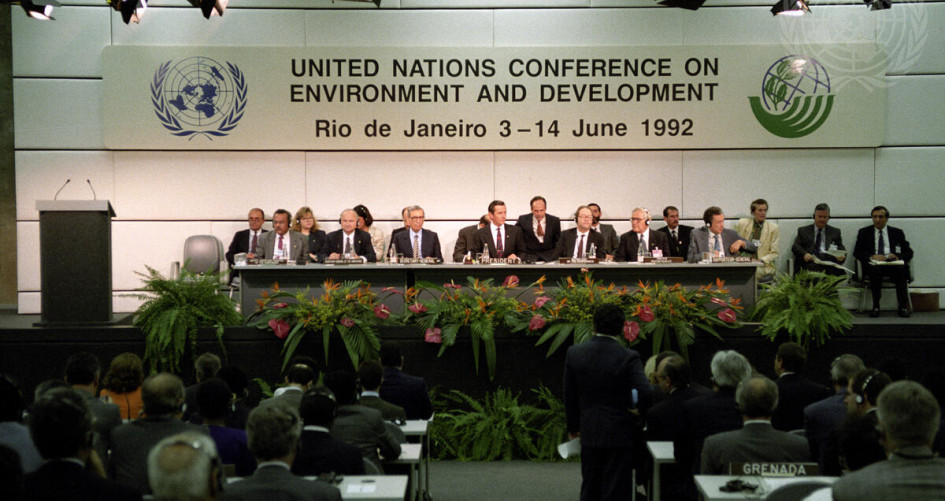
This year, the world gathers once again for COP30 in Belém, Brazil, recalling the spirits of the 1992 Rio Earth Summit, also held in Brazil. The key achievements of the Earth Summit, 1992, were three conventions: the United Nations Framework Convention on Climate Change (UNFCCC), the Convention on Biological Diversity (CBD), and the United Nations Convention to Combat Desertification (UNCCD). Just as the Rio Summit has had a long-lasting impact on global environmental policies, COP30 has also grabbed global attention with its aims to accelerate global response based on the results of the first Global Stocktake. (GST: a formal mechanism under Art 14 of the Paris Agreement that reviews global progress toward collective climate goals every 5 years and guides a climate action plan. Although the United States, the largest historical emitter of greenhouse gases, is officially absent from COP30, following its second withdrawal on 20 January 2025, from the Paris Agreement under the UNFCCC, this creates a significant vacuum in the global climate talks. On the other hand, the ambitious climate finance pledges made by developed nations, especially those in Europe, at the last COP29 in Baku, Azerbaijan, remained unfulfilled, leading to disappointment and frustration among developing nations, along with unresolved issues related to the fossil fuel transition and loss and damage support. (According to UNFCCC, loss and damage refers to financial and technical assistance provided to vulnerable developing nations to address adverse effects of climate change, which includes both economic and non-economic harms caused by sudden extreme events and slow-onset processes.)

Despite these abandonments of responsibility and avoidance of discussions on the fossil fuels transition by developed nations, hope still sparks at COP30. We believe the participants in the conference will not let their gatherings become mere trips to the Amazon that only bring frustration, as has happened before. Instead, this time, their stay in Belém will make history for the COPs, just as the Earth summit did in 1992, by fostering global climate solidarity that ensures equity and climate justice.
The annual global climate conference starts its journey from November 10-21, 2025. Let’s explore the long and impactful journey of COPs briefly, from their beginning in the early 1990s to the present day. The following sections discuss key agreements and achievements, while highlighting the significance of the COPs through the lens of legal implications.
The Earth Summit, 1992
One of the great achievements of the 1992 Earth Summit in Rio de Janeiro, Brazil, was the first foundational treaty for global climate action, the United Nations Framework Convention on Climate Change (UNFCCC). By raising awareness among people to the effects of climate change on Earth, this summit marked a moment when global warming became a household term (The Guardian, 1992), Since then, the UNFCCC has provided an international legal framework for cooperation, discussion, and action, with the core objective of stabilizing the emissions of greenhouse gases caused by human activities.
Moreover, the convention established the principle of “common but differentiated responsibilities,” placing the greater obligations on the industrialized states, as they have historically been the largest sources of greenhouse gas emissions and expected to lead emissions reductions. Today, UNFCCC has universal membership, with 198 parties. Among them, 197 are States and 1 regional organization, since the treaty entered into force on 21st March 1994.
Conference of the Parties (COP)
COP stands for “Conference of the Parties”, which is a universal phrase indicating a committee that is created after an international treaty is enforced, making the decisions on how that treaty is implemented. Therefore, there are many kinds of COPs, but the term COP is associated with the meetings of one committee, created after the signing of the UNFCCC.
The Conference of the Parties (COP) is the supreme decision-making body (governing body) of the United Nations Framework Convention on Climate Change (UNFCCC) that brings together representatives across the world annually to negotiate and review global environmental policies to mitigate human interference with the climate system. Since then, COPs have taken place annually (Except 2020), carrying out the legacy of the Earth Summit, 1992, through negotiation on how nations would be able to mitigate climate challenges in the year ahead.
The Earlier Phase of COPs (1995-2005)
In 1995, the first COP was held in Berlin, Germany. This COP-1 marked the official beginning of global cooperation among the member states. The key achievement of COP-1 was the adoption of the “Berlin Mandate”. The parties acknowledged that the voluntary commitments by the developed states to minimize their emissions to 1990 levels by the year 2000, were inadequate to meet the UNFCC’s ultimate goal.(UNFC, 1997)Therefore, the Berlin Mandate initiated a two-year negotiation process to draft a protocol that would impose legal bindings on emissions reduction targets for developed states for a period beyond 2000. This negotiation process eventually led to the adoption of the Kyoto Protocol at COP-3 in 1997.
The Kyoto Protocol was adopted on December 11th, 1997, in Japan at COP-3; however, it entered into force on February 16th, 2005, in Montreal, Canada at COP-11. It is the world’s first greenhouse gas emissions reduction treaty. This protocol legally binds industrialized states to cut greenhouse gas emissions by an average of 5% by the period of 2008-2012. Based on the principle of “common but differentiated responsibility and respective capacities” (CBDRRC), which places a heavier burden on developed nations because they are hugely responsible for the high levels of greenhouse gases in the atmosphere. (Article 3.1 of the UNFCCC, 1997) However, the treaty did not impose any binding obligations on the major carbon emitter developing countries like China and India. Indeed, the then-largest emitter, the U.S., signed the agreement in 1998 but never ratified it and eventually withdrew in 2001, arguing that this protocol unfairly exempted emerging economies.
Back in 1997, the world took a big step with the Kyoto Protocol. For the first time, a treaty was mandated to reduce greenhouse gas emissions from industrialized countries. No more empty promises. The treaty didn’t just set rules; it brought in creative solutions too.
Emissions Trading: One of the boldest ones was emissions trading. Basically, if a country managed to pollute less than it was allowed, it could sell its leftover “pollution credits” to another country that went over the limit. Suppose if Country A emits less than its limit, it can turn those extra credits into cash by selling them to Country B, which is over its limit. That’s how the carbon market started taking shape.
Clean Development Mechanism (CDM): The Clean Development Mechanism (CDM) gave developed countries a way to invest in green projects such as building wind farms or planting trees in developing nations. In return, they earned credits to count toward their own emissions targets. (EBSCO, 2022) So, everyone wins: global emissions drop, and the places that need sustainable development the most actually get it.
Join Implementation (JI): Then there’s Joint Implementation (JI). This one let industrialized countries team up, pool their resources, and share the rewards. Say one country pays for a wind farm in another; they both get credit for cutting emissions (EBSCO, 2022). It’s a pretty clever setup.
At COP-6, held in The Hague, Netherlands, in November 2000, negotiations failed due to disagreement on key issues, particularly on how to hold a state accountable for carbon sinks (land use, land-use change, and forestry- LULUCF), and funding mechanisms. However, the 2001 CoP-7, in Marrakesh, Morocco, was hailed as an example of resolving global problems through international cooperation. The Marrakesh Accords provided a detailed operational mechanism of the Kyoto Protocol and regulations for the carbon market mechanism, such as the Clean Development Mechanism. The Accords established three dedicated funds to support developing countries: 1. the Least Developed Countries Fund (LDCF), 2. the Special Climate Change Fund (SCCF), and 3. the Adaptation Fund (AF). (Ott, 2001)
Missed Targets and Incremental Progress (2006-2015)
Fast forward to the next decade, in 2009, at the COP-15 in Copenhagen, Denmark, the global leaders failed to deliver a binding treaty. Instead, they agreed to a political accord recognizing limiting warming to below 2°C, but without any commitments to emissions reductions. The Copenhagen Accord aimed to provide $30bn a year for the poor states from 2007 to 2012 and $100bn each year by 2020. A year later, at COP16 in Cancun, Mexico (2010), the 2°C target was reaffirmed and the pledges were formalized through the Cancún Agreements by creating the $100bln Green Climate Fund. (Grantham Research Institute on Climate Change and the Environment, 2024). A turning point was at COP17 (Durban, 2011), when the Durban Platform mandated a global treaty beyond 2020. Then, the famous
The Paris Agreement, 2015, is a legally binding International Treaty on Climate Change, adopted by 195 states at the COP21 in Paris, France, and entered into force on 4 November 2016. For the first time, every state committed to a goal of limiting the global average temperature to well below 2°C above pre-industrial levels and pursuing efforts to 1.5°C. (Paris Agreement, 2015, Article 2) Unlike the Kyoto Protocol, this agreement applies on both developed and developing countries. Also, this Paris Agreement introduced the concept of nationally determined contributions (NDCs) that made climate action a shared responsibility. (UNFCCC, 2023).
COPs in the Recent Era: Methane, Finance, & Loss & Damage (2015-2025)
In 2021, a report published on the Global Methane Assessment revealed that cutting methane emissions plays a critical role in slowing down the rate of global warming. The results showed that 45% cutting human-caused methane emissions by this decade could significantly help to limit global warming 1.5°C threshold and contribute to the improvement of health, environment, and economic benefits. (UNEP & CCAC, 2021) As such, cuts are crucial to achieving the Parish Agreement’s goal. At COP26, the Glasgow Climate Pact called for accelerating cuts and for the first time mentioned phasing down coal power. The landmark commitment to establish and operationalize the Loss and Damage Fund emerged from the CoP27 held in Sharm el-Sheikh, Egypt. The first Global Stocktake was the outcome of the COP28, containing both issues that were under negotiation and could be used by countries to develop climate plans in Dubai. Lastly, in the year 2024, COP29 reached a breakthrough agreement that developed nations would triple their finance, from the previous goal of USD 100 billion annually, to USD 300 billion by 2035.
COP30 in Belém: Hope for a History in the Heart of the Amazon
Brazil is well-positioned to host COP30, backed by its longstanding leadership on climate issues since the Earth Summit, 1992. From November 10 to 21, 2025, people from around the world will gather in Belém, known as the Gateway to the Amazon. This year, for the first time ever, COP will be held in the Amazon region, providing a unique opportunity to highlight the importance of this region on the stage of international climate diplomacy. The primary objectives of COP30 are to implement updated Nationally Determined Contributions (NDCs), review progress on the Global Stocktake, advance climate finance, and ensure a just transition away from fossil fuels.
However, for accommodate almost 50 thousand delegates, Brazil constructed a 13-kilometer highway, which sparked outrage at the beginning of 2025. Meanwhile, the offshore drilling for oil exploration near the Amazon River by the Brazilian government has also drawn global criticism.
Despite these controversies, the action agenda of COP30 brings hope as it aims to introduce a framework capable of mobilizing the actors to reinforce their commitments under the Paris Agreement. Guided by the results of the Global Stocktake (GST-1), COP30 agenda focuses on the efforts for mitigation, adaptation, finance, technology, and capacity-building.
The Legal Challenges
The importance of COPs lies in their mandate to bridge the gap between the current commitments and the 1.5°C target. Let’s be honest, the whole system for fighting climate change depends on what countries actually promise to do. When we look closer, the laws holding those promises together are full of holes and fuzzy language. If we really want to know whether deals like the Paris Agreement or the latest COP28 announcements will work, we have to dig into how these promises get enforced, what the legal obligations really mean, and how the word phasing out from fossil fuels keeps shifting. That’s what this next discussion tackles: the messy, complicated legal side of global climate action and what it means for our future.
The Enforcement Crisis of NDCs: The Toothless Tiger?
National Determined Contributions (NDCs) represent the efforts by the state parties to limit their domestic emissions. In other words, NDCs are the domestic initiatives taken by each country to reduce greenhouse gas (GHG) emissions to meet the 1.5°C goal of the Paris Agreement and post-2020 climate actions. Article 4 of the Paris Pact establishes these binding commitments. In terms of enforcement, the only legal achievement of the Paris Agreement, 2015, was securing universal adherence with a very flexible approach compared to the Kyoto Protocol, 1997. (Moscalewsky, 2022) With the lack of any punitive legal mechanism and no sanction for failing to meet the targets, this becomes the “toothless tiger” argument. Though many legal scholars argue that the legal strength of this agreement lies in its transparency and accountable framework, described as a “pledge and review” system.
The Obligation of Conduct Is Not the Obligation to Achieve: The Legal Nuance of Article 4
According to Article 4 of the Paris Agreement, “each party shall prepare, communicate and maintain” a Nationally Determined Contribution….” and “shall pursue domestic mitigation measures, to achieve the objectives of such contributions.” (Art 4) Here, the twist lies: this provision explicitly imposes a legal obligation upon each state party to submit NDCs and pursue domestic measures; however irony is that achieving the NDC goals is not legally enforceable. Therefore, this phrase creates a legally binding obligation of conduct (taking all measures the target domestically), which differs from an obligation to achieve ( the result) the goals of Paris PAct. (Bodansky, 2016)
Though Art 4.3 of the Paris Agreement requires each successive NDC submitted by a state party to represent a progression beyond the previous one, it attempts to tackle the legal nuance. Therefore, submitting a less ambitious NDC could constitute a procedural breach under the Agreement. The progression principle in this agreement acts as a binding procedural framework that strengthens accountability by requiring countries to increase measures rather than remaining static or regressing.
The Legal Ambiguity of "Transitioning Away" from Fossil Fuels
The significance of COP28 lies in the call for "to transition away from fossil fuels in energy systems, in a just, orderly and equitable manner, accelerating action in this critical decade, so as to achieve net zero by 2050.”(UNFCC, 2023) This achievement serves as a foundation for domestic policymaking to determine how they will contribute to this energy transition. However, the absence of an explicit commitment to phase out fossil fuels and the inclusion of vague modifiers like "just, orderly, and equitable" again reflected the unambitious steps towards fossil fuel transition. But keeping the hope to address this global concern regarding fuels in the next COP, the UN Climate Change Executive Secretary hailed the outcomes of COP28 as “the beginning of the end of the fossil fuel era.”
Thus, one of the core legal arguments for COP 30 might be whether the phrase "transitioning away" can be upgraded, or at least interpreted, as a legally stronger obligation.
Fund Responding to Loss and Damage (FRLD): A Step toward Equity and Climate Justice
Although developing nations have contributed less to greenhouse gas emissions compared to the historically larger emitter countries, they disproportionately suffer from the adverse effects of climate change. Many face irreparable loss and damage due to the consequences caused by others’ emissions, along with an overwhelming financial crisis as a result. In response to this inequity, developing countries, particularly small island states and African countries, demanded a financial mechanism to address the adverse effects of climate. Their advocacy influenced the parties to the UNFCCC to agree on the establishment of a fund to address climate-induced losses that go beyond adaptation, such as floods, sea-level rise, and other climate hazards. (UNFCCC, 2022).
Warsaw International Mechanism (WIM) was established to address and follow the loss and damage associated with the impacts of climate change. The Loss and Damage Fund at COP27, which officially began operation on the first day of COP28 in Dubai, is considered a symbolic step toward climate justice (UNEP, 2023). Approximately $19 million was pledged by Sweden at COP29, bringing the total funding to more than $720M. (COP29, 2024). FRLD consists of 26 members, confirming a balance between developed and developing countries.
The FRLD reflects the moral and political will of the parties to the UNFCCC, which is a core pillar of climate action along with mitigation and adaptation. This step by the global leaders acknowledges that a compensatory mechanism can act as a tool to ensure climate justice and address inequity arising from climate-induced damages. However, still, questions remain regarding the immense gap between the financial pledges and the estimated amount needed for the climate-induced loss and damage, as well as the adequate and equitable accessibility of this fund. As research by the UN Environment Program (UNEP) indicated, the pledges to developing countries are five to ten times below the estimated needs of over $300 billion per year by 2030. (The Adaptation Gap Report, 2022)
Ahead of the COP30in October 2025, at the 7th board meeting of the FRLD, the board took critical decisions on its first call for the funding requests, to operationalize the Barbados Implementation Modalities (BIM). This marks the launch of a historic $250 million initiative for frontline communities' funding requests under the BIM. This step is upholding its commitment to leave no one behind. Thus, the parties to the UNFCCC attempt to use the FRLD as an instrument to address the unavoidable and irreversible impacts of climate emergency. Yet, there is a legal debate exists: is the pledges to the FRLD always be a voluntary participation? When will the members of the climate conference realize that this is a matter of legal responsibility?
Belém: A Moment for Climate Justice
In the “letter to the world”, the Brazilian Ambassador, André Corrêa do Lago, urged the world to admit the gravity of climate change by saying that
“Change is inevitable – either by choice or by catastrophe. If global warming is left unchecked,”
The world keeps its eyes on Belém, as COP30 kicks off right in Brazil, the heart of the Amazon, where so many climate milestones started. There’s a real feeling of hope in the air. This time, the world isn’t just talking about change; it’s got a shot at finally making it happen. After decades of struggle and big promises, COP30 needs to set real, binding targets to ditch fossil fuels fast, keep climate finance promises, and get money flowing through the Loss and Damage Fund. This isn’t just about policies; it’s fair. Don’t let the Loss and Damage Fund gather dust. Fill it up and make sure the countries suffering the most can actually get the help they need. Open things up. Countries should show what they’re doing and stick to their climate pledges. No more smoke and mirrors. Listen to the people who usually get ignored. Bring in voices from developing nations and Indigenous communities. Let them lead. And don’t forget about Amazon. Protect it and let the world see what’s possible. Use COP30 as a stage to show real action. Right now, we get to decide what story we’re telling about our future. Let’s make it one of hope, fairness, and real change.


Comments