From Dependency to Prosperity: Reclaiming Our Future Through Energy Sovereignty
Updated: Apr 21
In the changing landscape global order, we currently stand at a unique paradox. As much as technology has advanced and the world has become more connected, the fundamental factor of existence, energy, is now increasingly more vulnerable. From the madness on the streets of Dhaka to the expansive industries in Europe, there is only one thing we need to understand that energy has evolved from being a factor of human rights to a geopolitical tool. Energy usage from switching lights off to raising sails on ships is no longer about economic dynamics; rather, it is all about geopolitics.

Navigating the Reality of Energy Vulnerability
It appears we live in an energy system characterized by political tension in regions outside our immediate political environment. The US-Israel-Iran war in the middle east and Russia-Ukraine War have affected global supply chains, causing economic shockwaves around the globe. Although these political crises do not seem directly tied to our domestic politics, they have affected our economy significantly. Periphery countries, influenced by global power dynamics, experience economic hardships such as factory shutdowns, power outages, or an increased cost of basic food necessities such as bread.
For developing nations and least developed countries, this problem is more severe since the very production of energy leaves them vulnerable. The energy sources used are unevenly distributed globally, where several nations have a monopoly of global oil, gas, and coal. Hence, global economic stability rests upon these nations' policies and decision-making processes, with no real choice for many other countries.
The repercussions of this reality are dire, threatening the economic and social well-being of nations. A rise in global oil prices results in an unenviable position for importing nations that struggle to gather enough resources just to ensure the supply of essential fuel. In times like these, governments facing budget constraints find themselves in a difficult predicament as they try to meet all their national duties. It leaves them to decide whether to maintain a functioning national grid or invest in public health and other social development needs. This can result in an unhealthy cycle that affects the sovereign economic and social stability of nations.
This way, fuel shortages could trigger political unrest, leading to the fall of regimes that cannot fulfil their commitments to their people anymore. This historical trend is evident from several periods, particularly the 1970s and subsequent periods. Despite this pattern, many countries face the same problems in modern times, trying to survive within the existing unstable framework.
What does Energy Security Cost Us?
Energy security has traditionally been seen as the goal for developing countries. On the surface, the idea of energy security sounds reasonable; however, the way of pursuing energy security has shown itself to be rather dangerous. Energy security, according to the common definition, presupposes the availability of an energy resource at a fair price. Nevertheless, in terms of deeper meaning, energy security may be viewed as a destructive concept as it concentrates on acquiring the energy source without thinking about its origin or impact on national economy.
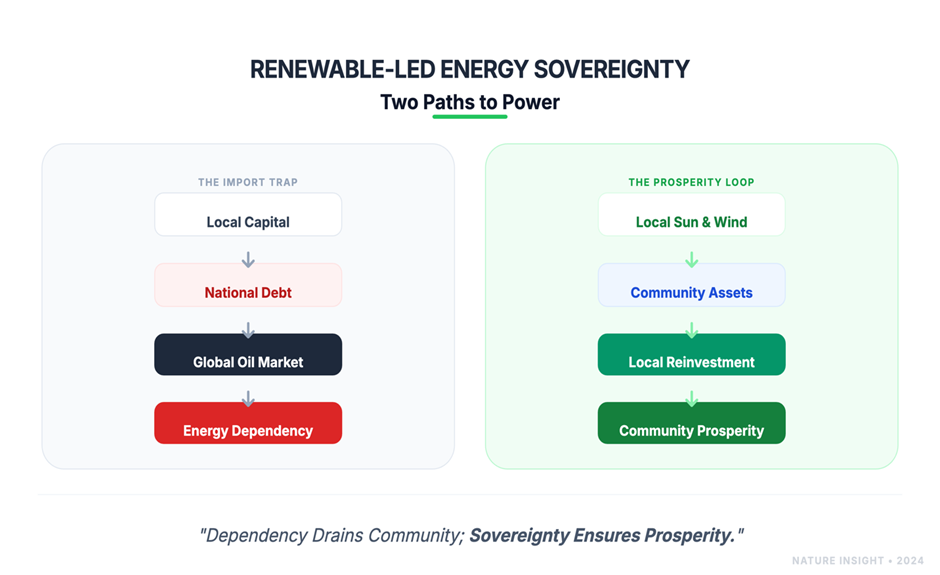
The energy industry in its current state is built upon one idea, i.e. acquisition of any energy resources. That process usually leads to falling into what can be referred to as "the Import Trap." As a result, the country obtains tremendous debt and large energy-producing facilities powered by imported oil and gas resources. Then, to continue paying for coal, gas or oil that is used in the facilities, the country has to obtain further loans. In this manner, energy security results in slavery.
According to M. Zakir Hossain Khan in his book on Natural Rights-Led Governance (NRLG), pursuit of energy regardless of price jeopardizes national security. National security, according to his opinion, cannot be provided through other countries. In case of losing sovereignty or independence while securing some energy sources, the country will remain unprotected in case of changes in the world politics. The basic principle behind it is obvious, as "you do not own your future until you have control over energy production."
The Turning Tide: A Tale of Two Communities
To understand the weight of this dependency, we only need to look at the stories of two neighbouring villages. One village relies on the traditional national grid - a massive, sprawling network fed by an aging furnace miles away that burns imported fuel. When the global price of oil spikes, or when a conflict thousands of miles away blocks a shipping lane, the grid falters. The lights dim, the local grain mill grinds to a halt, and the village’s meager savings are swallowed by rising bills. This is a community living in the shadow of the "Import Trap."
But just across the river, a different story is unfolding. This second village has embraced "Nature Smart Energy." They didn't wait for a billion-dollar investment in a centralized grid that might never reach them. Instead, they took ownership. They installed a community-managed solar micro-grid, turning their rooftops into a power plant. Here, the "fuel" is the sun that greets them every morning.
When the global oil markets tumble into chaos, this community remains untouched. Their children study under bright LEDs, their small businesses thrive with predictable costs, and most importantly, the money that used to flee the country to pay for oil now stays home. This is the essence of community prosperity. It isn't just about having electricity; it’s about the dignity of owning the means to produce it.
Distributed Renewables: The Shield to Geopolitics of Energy
This transition to distributed sovereignty provides protection against the militarization of energy supplies. In cases of armed conflict, you cannot punish the sun and the wind. Therefore, if we manufacture our own energy, no force can make us fail.
Consider a developing country that successfully reduces its energy expenses by half without reducing its energy output. With the help of these technologies, a Just Transition will become possible for people previously dependent on coal to receive their electricity from sustainable energy sources. The essence is the transfer of ownership to the community.
In this regard, the notion of community off-grid becomes an essential instrument for local empowerment. This will allow citizens to take advantage of their natural rights and protect their budgets from health and educational sectors, preventing them from going into debt for buying oil.
Reclaiming the Five Pillars of Sovereignty
The achievement of a future like this requires an expansion of our definition of “security,” and requires that we focus on the five components of Energy Sovereignty. First is Nature-Smart, meaning that it will be essential for us to realize that our power must come from nature, and that this power cannot be ruined in any way. Second is Sovereignty, where we should prioritize using local sources that cannot be taken over by any external force. Third is resilience, as we must protect local populations from changes in world prices. We build resilience by shielding our local economies from the turbulence of global price shocks. Fourth, we advance decentralization, breaking down the massive, fragile structures of the past into agile, local networks. And finally, we streamline Community Stewardship, ensuring that the value created by energy stays within the community that produces it to ensure prosperity.
A New Social Contract
The idea of energy sovereignty represents an unprecedented change in the nature of the social contract itself, where one must understand that development does not imply a burden that must be carried by the world, but rather the wealth derived from the energy and resource potentials of their own land and sky. Energy sovereignty also represents a change from consumers to owners.
Currently, it can be said that in the choice between different types of energy, there lies a choice between two lifestyles. A world connected with fossil energy based on centralization, volatility, and constant cycles represents one side. Meanwhile, the other represents a world where the source of energy is renewable and local control is possible.
Instead of waiting for consequences resulting from shocks occurring around the globe, people should focus on creating the future themselves, preparing to weather any future crisis that might happen. Technology, natural rights, and needs are sufficient for taking such action.


Comments