Innovation without Balance: Urban Flood and the Sustainability Crisis in china and Beyond
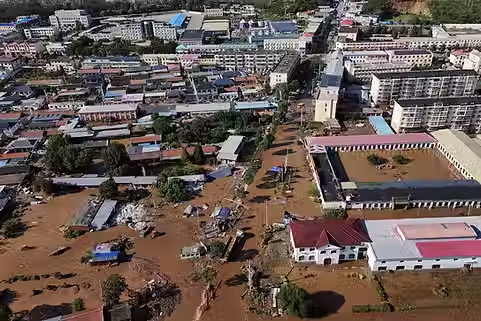
According to the International Monetary Fund, the People’s Republic of China is a global superpower and the world's second-largest economy, with a projected GDP of $19.23 trillion in 2025. (IMF, July 2025) Over the last decade, this country has had a tremendous influence on geopolitics, global trade, and technology. However, amid the symbols of its high-tech and industrial supremacy, shiny city skyscrapers, high-speed rail, and overseas bridges, images from recent floods have exposed the environmental and urban sustainability crises underlying its rapid urbanization.
Living standards in the city cover more than economic prosperity. The standards represent a comprehensive quality of life that cities offer to their residents. The four pillars of standard of living include: housing security that guarantees safe, affordable, and sustainable shelter; infrastructure reliability that allows consistent access to clean water, sanitation, electricity, and transportation; health access, which also includes both access to health care services and immunity to environmental hazards; and economic stability, which allows citizens to afford basic needs without reducing other basic needs. These are interrelated, and they constitute the basis of what the United Nations has established as sufficient urban housing and sustainable human settlements.
The devastating floods across China in 2025 have shattered all of these pillars. When floodwaters from the Qingshui River burst its banks and killed 31 elderly residents at the Taishitun Town Elderly Care Center in the Miyun district, about a two-hour drive from central Beijing, the capital of China. The tragedy exposed how even a global superpower remains vulnerable to climate-driven disasters that systematically erode urban living standards.
Since mainstream social media like Facebook and WhatsApp are banned in China, images and news of the floods were not widely circulated, so we are barely aware of how fragile Chinese cities could be during floods and how elderly people not being able to move died while trapped in the senior care center. Furthermore, the Global Climate Risk Index 2025 revealed that China ranked the 2nd most affected country by extreme weather events over the past 30 years. (Germanwatch, 2025)
During the summer floods and heavy rainfalls, millions evacuated from their homes, and pictures show how the big cities in China were submerged under water. This flood disaster mirrors a growing global pattern in which rapid urbanization and climate-induced extreme weather increasingly threaten the standard of living in cities worldwide.
Urban Floods and the Crisis of Living Standards
China's Flood Crisis: When Infrastructure Fails
Throughout this year, China has experienced unprecedented floods, revealing the vulnerability of its massive urban expansion. This flood not only displaced thousands, damaged infrastructure, but also reflects a growing global urban crisis, which eventually threatens the quality of life.
During the summer between July and August, more than 60 people died and thousands of residents were evacuated, with the capital, Beijing, suffering its worst flooding in years. According to the state broadcaster Chinese Central Television, CCTV, as of 8th August, continuous rain, which had triggered flash floods that left 10 people dead and 33 missing, and displaced nearly ten thousand residents. Most tragically, 31 elders died trapped in an elderly care center, unable to escape from the rapidly rising waters. Later, in September, whenna Typhoon Ragasa struck China’s southern economic hub in Guangdong province, forcing nearly 2 million residents to evacuate, as per the state-run Xinhua news agency. The government of China allocated a disaster relief of over 6 billion yuan, which shows both the financial burden and the inadequacy of existing urban resilience measures.
The Global Urban Flooding Challenges
China's floods are an example of an international urban vulnerability trend that transcends national borders. In 2025, Indonesian cities like Jakarta, Bogor, Depok, Tangerang, and Bekasi (Jabodetabek) regions were massively flooded, displacing more than 90,000 people. These floods stemmed not only from heavy rainfall but also from the inadequate flood defenses and uncontrolled urban development.
While I am writing this, the neighboring city, Kolkata, in the eastern Indian state of West Bengal, has recorded its heaviest rainfall in 39 years amidst the Durga Puja festival around the corner, killing at least 12 people. According to the BBC News, 9 of those deaths were caused by electrocution in waterlogged areas. Poor urban drainage, inadequate infrastructure are considered the primary causes. (BBC,2025)
Meanwhile, Dhaka, the capital of Bangladesh, has continuously witnessed waterlogging throughout 2025, and even short-term (three hours) rainfall resulted in extensive urban paralysis. It has been identified that since 2010, Dhaka has lost an area of 3,440 acres of designated flood flow zones and waterbodies, and consequently, the city’s water carrying capacity fell from 20.57 percent in 1995 to merely 2.9 percent by 2023.
Standard of Living: Reality of Urban Flooding for City Residents
Floods in the city affect normal life in a severe manner. The flood in cities not only disrupts daily life, but beyond the inundation of streets and neighborhoods, it undermines the very fabric of urban living. It displaces millions of people, causes loss of homes and livelihood, hinders access to clean water and sanitation, and becomes a health risk with the incidence of water-borne diseases and scarcity of mental health stressors. Living becomes intolerable, and homeless individuals dwell in makeshift accommodations or temporary residential homes. In March 2025, Jakarta Floods displaced 90,000 people. According to estimates of the World Bank, yearly urban flooding may cost a city 2-3 percent of gross domestic product
The health effects are especially adverse in the cities where people live in large numbers. Sewerage systems are overwhelmed by flooding that discharges raw sewage waste into communities with a large potential for water-borne diseases. Flood pollution with fecal matter poses colossal social health hazards in the developing classes' urban areas, where open drainage sewage is used. The number number of deaths by electrocution in Kolkata indicates that urban infrastructure is very dangerous during floods. As a case in point, during the recent China floods, local people experienced fatalities in areas prone to such destruction, including a nearby Beijing elderly care facility, highlighting glaring failures in preparation and reaction between urban regions.
The infrastructure, beginning with the transport system and ending with the healthcare services, risks collapsing under the floods, for instance, the tragedy happened at the elderly home in China, with subsequent social and economic impacts. It is the human struggle with these difficulties that highlights how unstable living conditions really are in the cities when the floods set in.
Exploring Reasons behind China’s Sinking Cities and Rising Flood Risks
While exploring the articles, research related to China’s floods, I came across a significant article titled “Why Are Chinese Cities Sinking? A Comprehensive Analysis of Causes, Effects and Solutions," published in 2024 in the environmental news site Earth.Org, which discusses how cities in China become vulnerable to climate disasters. In a thoughtful analysis, the author Omolere dissects the complex reasons behind this alarming trend.
According to the writer, one of the key factors for China's sinking cities is the excessive groundwater extraction for agricultural, industrial, and domestic uses. This over-extraction has lowered water tables considerably, causing the earth above it to compress and sink. In the capital of the country, Beijing, the over-pumping of groundwater has been responsible for as much as 70% of the land subsidence that has been measured.(Omolere, 2024). The massive urban infrastructure, mainly high-rise skyscrapers, adds further pressure, which compacts the soil. As well as the urban heat island effect increases the demand for water, thereby inducing even greater groundwater withdrawal and shrinkage of surface soil. Collectively, according to the writer, these attributes illustrate a concerning picture of the reasons for China's sinking cities and the resulting flood risks.
From Grey to Green, Toward Sustainable Urban Living
Addressing the growing challenges of urban flooding as part of improving living standards requires a paradigm shift toward sustainable, inclusive urban design.
The emerging “Sponge City” concept integrates green infrastructure that is nature-based solutions to drainage for strengthening urban flood resilience with traditional “grey” “grey” infrastructure, which relies on concrete drainage systems. Green infrastructure includes a web of natural and semi-natural systems, such as parks, green roofs, wetlands, and permeable pavements, designed to manage stormwater runoff and promote groundwater recharge. By imitating natural systems in hydrology to absorb rainwater and simultaneously decrease the amount of runoff and velocity of surface runoff. As well as this also reduces the immense pressure on conventional drainage systems and mitigates the risk of flooding. Not only is this strategy a cost-effective flood control method, but a host of co-benefits will be provided that will help create a healthier and more sustainable urban environment. The integration of "blue-green" systems into urban planning is crucial for creating resilient cities capable of adapting to future climate uncertainties.
Now, what is Sponge City?
Yu Kongjian, one of the most prominent architects in China, uses the sponge as a metaphor for urban rainwater storage capacity. In contrast to the conventional control of flood waters, which focuses on moving water away as quickly as possible using engineered drainage systems, such as pipes and water channels, a sponge city develops an opposite system by focusing on absorbing the water and slowly releasing it, like a sponge. China's Sponge Cities Program provides valuable insights as to how flood resilience can be included in closely stipulated urban living standards.
Reimagining Urban Standards of Living
Considering the floods of 2025, across cities in China, Indonesia, India, and Bangladesh, are a reminder that our existing models of urban development are inconsistent with the current realities of climate change. Cities that prioritize rapid economic development over urban sustainability, and forget the very prosperity and well-being they were designed to create, will eventually fall into a trap of vulnerability.
Urban living standards need to be redefined so that the notion of climate resilience can be fully incorporated on the path forward. This means planning cities that can work with natural water systems, rather than against them, and where vulnerable populations have the right to safe, flood-resilient housing and infrastructure.

Globally, climate change has impacted cities around the world; now it is time to make a decision between taking action and redefining development practice based on sustainable development, or continuously enduring the persistent disasters, displacement, and deteriorating living conditions.
Prioritizing short-term development instead of lon
g-term sustainability has resulted in devastating urban floods. The question now is whether urban leaders will pay attention to such warnings and start creating cities that are truly worthy of the climate challenge ahead. Hundreds of millions of people in cities rely on their ability to get this choice right, to live.
These recent Chinese flooding and other such incidents send a clear message to the world that the urban standards of living can only be accompanied by urban and climate resilience. We need to take immediate action to reframe the way cities rise, how they manage water, and how they safeguard their inhabitants, unless the threat of flooding will slowly heighten the erosion of urban wellbeing and sustainability, thereby deteriorating living standards.



Comments