The Story of How Humanity Awoke to Protect Its Planet
A Journey Through Environmental Awareness, International Law, and Climate Change.

Long before the concepts of "climate change" or "sustainability" were formalized, people across the world already understood instinctively that nature was sacred. Ancient farmers guarded their water sources; forest dwellers took only what they needed, and spiritual traditions across continents taught respect for the earth. But these were local, scattered efforts with quiet whispers of stewardship in an age when nature still seemed boundless.
Then came the machines.
After the Second World War, humanity rebuilt fast. Factories roared to life; cities swelled, and technology promised endless progress. But behind that promise came poison. Rivers turned black, skies grew grey, and fish floated lifeless in once-clear waters. In Japan, mercury poisoning in Minamata shocked the world; in London, deadly smog smothered the city. The planet was paying the price for industrial glory.
Scientists began warning us that our atmosphere, once invisible and infinite, was being quietly altered by our own hands. And slowly, people began to listen.
When the Earth Found Its Voice
In 1962, a quiet woman named Rachel Carson released a book called Silent Spring. Her words were like a thunderclap. She wrote of birds that no longer sang, of soil poisoned by human carelessness. The world listened, and for the first time, people began to question whether progress was worth the silence of spring.
From those pages, movement grew. Young people marched, Earth Day was born, and governments once indifferent began to create environmental agencies. The green voice of the planet had found its echo.
1972: The World Gathers in Stockholm
Then came a defining moment: the 1972 Stockholm Conference, the first great gathering of nations for the sake of the Earth. Representatives from 113 countries sat together, not as rivals, but as guardians. They declared that every human being has “the right to a life of dignity in an environment of quality.”
From that meeting, a new institution emerged, the United Nations Environment Programme (UNEP), charged with uniting the world’s environmental efforts. It was as if the planet itself had finally been given a seat at the table of nations.
1982: When Humanity Looked at Nature Differently
Ten years later, the World Charter for Nature reminded us of something profound, that nature’s value was not only in what it gives us but in its very existence. The Charter spoke of balance, restraint, and respect, ideas that had once guided our ancestors but had been forgotten in the race for progress.
Humanity was beginning to be remembered.
1987: The Brundtland Report - A New Vision for the Future
By the 1980s, the world realized that simply protecting the planet was not enough; we needed to transform the way we developed. The Brundtland Report, Our Common Future, introduced a concept that would redefine sustainability: meeting the needs of the present without compromising the ability of future generations to meet theirs. For the first time, the environment, economy, and society were united within a single framework of responsibility and balance. A new moral compass for global development has been set up.
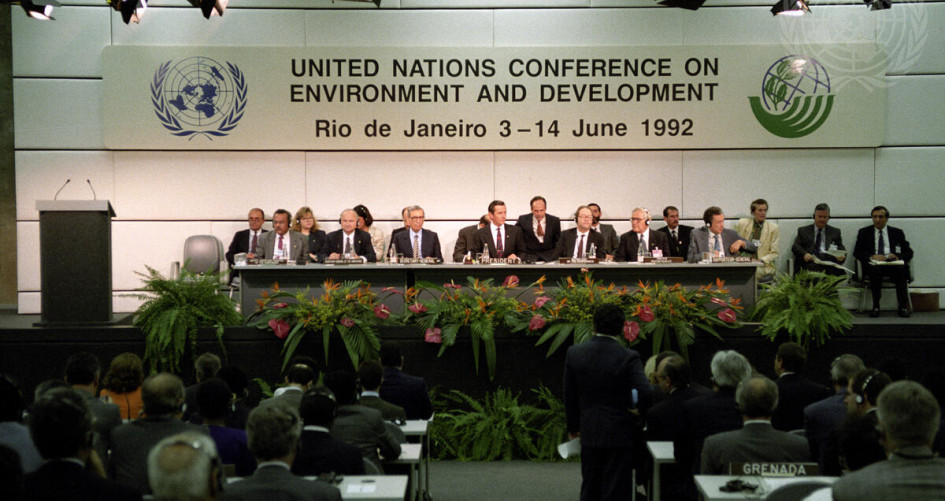
1992: The Rio Earth Summit - When the World Chose Cooperation
In 1992, world leaders gathered in Rio de Janeiro under the warm Brazilian sun for the historic Earth Summit, marking a new era in global cooperation for the planet’s future. From this landmark event emerged three pivotal agreements, three promises to the Earth, the UNFCCC to confront climate change, the CBD to protect biodiversity, and the UNCCD to combat desertification and land degradation. Alongside these, leaders adopted Agenda 21, a bold blueprint to make sustainability the foundation of every nation’s development. The Earth Summit stood as a powerful reminder that protecting nature was no longer a choice but a shared duty of all humanity.
The Birth of Climate Diplomacy
Around the same time, scientists had proven beyond doubt that greenhouse gases were warming the planet. To face this growing danger, nations adopted the UN Framework Convention on Climate Change (UNFCCC), a landmark treaty that recognized one truth: we all share the same sky, but not the same responsibilities.
This principle, called Common but Differentiated Responsibilities (CBDR), acknowledged that wealthy nations, who had long fueled their growth with fossil energy, must take the lead in cleaning the air they had filled.
To make this treaty work, countries would meet every year in gatherings known as the Conference of the Parties, or COP. And thus began the long
and complex story of global climate negotiation.
From Berlin to Kyoto: The First Promises
The first COP took place in Berlin in 1995. There, nations agreed that stronger action was needed. Two years later, in Kyoto, Japan, the world adopted the Kyoto Protocol, the first treaty with binding emission reduction targets for developed countries.
For the first time, rich nations were legally bound to cut their pollution. The protocol even created new ways to cooperate, such as Clean Development Mechanism (CDM), allowing investment in greener projects in developing countries. The idea was elegant: help others grow cleanly while reducing global emissions together.
Copenhagen to Paris: From Division to Unity
But the journey was far from smooth. In 2009, at COP15 in Copenhagen, expectations were sky-high, yet the summit ended in disappointment. Countries could not agree on how to share the burden. Still, something important had changed: emerging powers like China, India, and Brazil had taken center stage. Climate diplomacy was no longer a Western conversation; it was truly global.
Then, in 2015, redemption came. In Paris, 196 nations stood together and adopted the Paris Agreement, a treaty that transcended old divides. Every nation, rich or poor, would now set its own climate plan called a Nationally Determined Contribution (NDC).
Its goal: to keep global warming well below 2°C and ideally within 1.5°C. The Agreement promised transparency, adaptation, and, crucially, climate finance, with developed countries pledging $100 billion annually to help vulnerable nations.
For the first time in history, the entire planet was united by a shared promise of its future.
Recent COPs: Progress Amidst Challenge
The years that followed saw both hope and hardship.
At COP26 in Glasgow (2021), nations agreed to phase down coal and phase out inefficient fossil fuel subsidies. The Glasgow Pact urged countries to net-zero emissions and completed the rulebook for the Paris Agreement. Then, COP27 in Egypt (2022) delivered a breakthrough the creation of the Loss and Damage Fund, a long-awaited lifeline for nations suffering from floods, droughts, and storms they did little to cause. By COP28 in Dubai (2023), the first Global Stocktake revealed both progress and peril: while renewable energy was rising, emissions were still too high. The world was urged to accelerate the shift away from fossil fuels, invest in adaptation, and honor financial commitments to the most vulnerable.
The Road Ahead: A Story Still Being Written
The story of international environmental law is far from over. From Stockholm to Paris, from pollution control to planetary justice, humanity has traveled a long way, yet the destination remains distant.
Each COP, each treaty, each protest is another chapter in this shared human journey, a journey not just to protect the planet, but to rediscover our place within it. Our challenge now is not to write more declarations, but to turn promises into action to make sure that the story our grandchildren inherit is one of courage, not regret.
Because the Earth has always been generous. The real question is, can we learn to give it back?


Comments