The Restless Horizon: A Biography of Earth’s Landscapes

To walk across the Earth is to walk across a battlefield. We tend to view our planet as a static stage—solid rock, immovable mountains, permanent coastlines. But this is an illusion of time. To a geologist, the Earth is a churning, volatile entity caught in a state of dynamic equilibrium.
Every valley and peak you see is the result of an ancient, silent war between two colossal forces. From below, endogenic forces (driven by the planet’s internal heat) shove the crust upward. From above, exogenic forces (sun, wind, water, and ice) conspire to tear it back down.
Here is the story of how these forces have sculpted the seven faces of our world.
I. The collision: How Mountains Are Folded and Broken
The story of the mountains is a story of stress. The Earth’s crust is not a single shell but a jigsaw puzzle of tectonic plates that are constantly jostling for position.
When two continental plates crash into each other, they refuse to sink. Instead, they buckle. This is compressional stress. Imagine pushing a rug from both ends; the middle rises. This is how fold mountains like the Himalayas are born. The rock layers are twisted into upward arches (anticlines) and downward troughs (synclines), creating the jagged, soaring peaks that are still rising today.
But not all mountains are born from collision. Some are born from tension. When the crust is pulled apart at divergent boundaries, the rock fractures. Massive blocks of the Earth slide downward, creating grabens (rift valleys), while others remain high as Horsts. This Fault-Block mechanic is what created the "Basin and Range" of the American West—a rhythmic landscape of steep, straight cliffs alternating with flat valley floors.

II. The Fire: The Architectures of Magma
While tectonic plates push rock up, volcanoes pour it out. The shape of a volcanic landscape is determined by a single, crucial variable: viscosity (thickness).
In places like Hawaii, the magma is low in silica. It flows like hot syrup. This "effusive" lava travels miles before cooling, building broad, gently sloping domes known as shield volcanoes.
Compare that to the Ring of Fire (e.g., Mt. Fuji). Here, the magma is rich in silica, making it thick and sticky. It traps gases until the pressure becomes unbearable. When it finally bursts, it builds stratovolcanoes—steep, symmetrical cones constructed from alternating layers of ash and viscous lava.
Sometimes, the Earth simply cracks open and bleeds. In events known as flood basalts, lava floods thousands of square miles, cooling into the massive, stepped plateaus seen in India’s Deccan Traps.

III. The Flow: The Hydraulic Chisel
If tectonics builds the stage, water is the primary actor. A river is an energy machine, converting the potential energy of height into the kinetic energy of motion.
In the mountains, a young river is hungry. It uses hydraulic action and abrasion to drill vertically into the bedrock. This destabilizes the banks, causing them to collapse inward and creating the classic V-Shaped Valley.
As the river reaches the flatlands, it loses the energy to cut down, so it starts to swing side-to-side. It develops a helical flow—a corkscrew current that eats away the outer banks and drops sediment on the inner banks. The result is the winding loop of the Meander.
Finally, when the river hits the ocean, it hits a wall of water. Its flow stops. It drops its burden of silt—aided by salt water which clumps the clay particles together (flocculation)—building the fertile, fan-shaped lands we call Deltas.

IV. The Ice: The Weight of the World
Water flows, but ice scours. During the ice ages, glaciers moved across the land like slow-motion bulldozers.
Because ice is a high-viscosity fluid, it doesn't just cut the bottom of a valley; it grinds the sides too. Where a river cuts a "V," a glacier carves a massive, parabolic U-shaped valley. When the ice retreats and the sea level rises, the ocean floods these deep troughs to create Fjords.
But ice shapes the earth even after it melts. The ice sheets were so heavy that they actually depressed the Earth's crust into the mantle. Now that the ice is gone, the land is slowly springing back up—a process called Isostatic Rebound. This is why, in Canada and Scandinavia, you can find ancient beaches raised hundreds of feet into the air.

V. The Wind: The Architecture of Dryness
In the arid zones, where water is scarce, the wind becomes the master sculptor.
We often picture deserts as sandy oceans, but scientifically, these dune fields are called Ergs. Here, the wind sorts the sand grains through saltation (bouncing). The shape of the dunes tells you the wind’s history: crescent-shaped Barchan dunes mean the wind blows one way; Star dunes mean the wind attacks from all sides.
But the wind also strips the land bare. In a process called deflation, the wind blows away all the fine dust, leaving only heavy, interlocking stones behind. This creates Regs, or "desert pavement"—a natural armor of varnished rock that protects the earth beneath.

VI. The Dissolution: The Chemical Saw
Some of the most surreal landscapes on Earth were not physically broken but chemically dissolved. This is karst topography.
It begins with invisible chemistry. Rainwater picks up carbon dioxide from the air, turning into weak carbonic acid. When this falls on limestone (CaCO₃CaCO₃), it eats the rock away.
On the surface, the ground collapses into sinkholes. Beneath the surface, the water hollows out massive cathedrals of stone—caves adorned with speleothems (stalactites) formed by dripping mineral water. In advanced stages, like in Guilin, China, the entire plateau dissolves, leaving behind only resistant, tower-like pillars of limestone standing guard over the plains.

VII. The Edge: The Coastal Interface
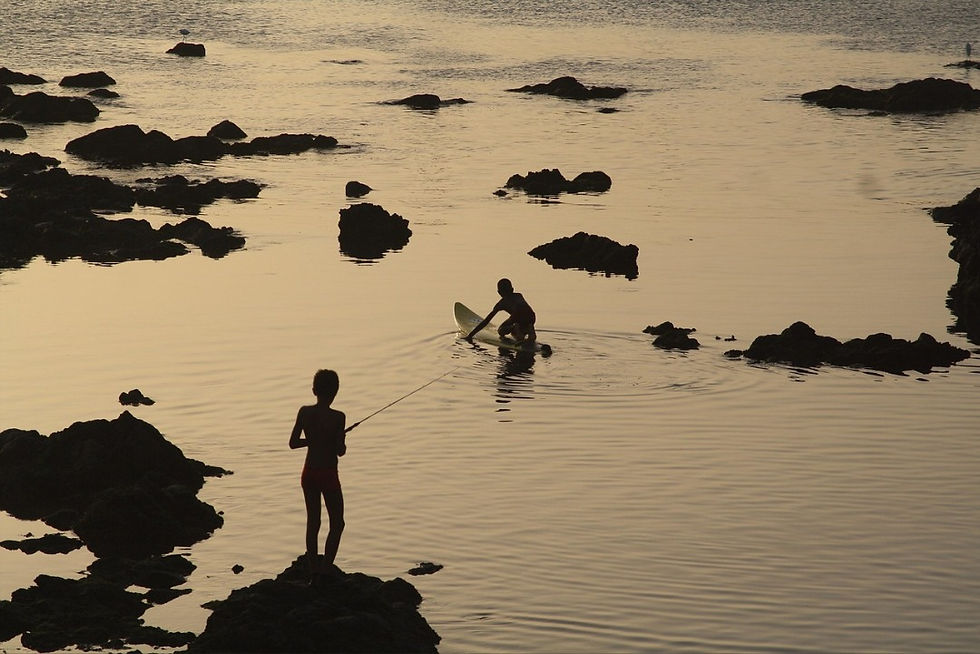
Finally, we reach the coast—the violent meeting point of the lithosphere (rock) and hydrosphere
(water).
Here, the waves attack the land with hydraulic pressure. It is a predictable sequence of destruction: the waves find a crack and scour it into a cave. The cave punches through the headland to form an arch. The arch collapses, leaving a lonely pillar called a stack, which eventually crumbles into a stump.
But the ocean gives as well as it takes. Currents moving parallel to the shore (longshore drift) carry tons of sand, depositing them in calm waters to form spits and barrier islands, reshaping the map with every tide.

The Final View The next time you look at a landscape, look closer. Do not just see a hill; see the tectonic fold that raised it. Do not just see a valley; see the river that cut it or the glacier that gouged it. The Earth is not a finished painting. It is a work in progress, rewritten every day by the physics of nature.


Comments